Stop Buying the Hype: What You Actually Need to Start Fermenting at Home
Scroll through any homesteading subreddit or fermentation Facebook group long enough and you'll see the same story play out over and over. Someone drops $120 on a gleaming fermentation starter kit, tries it twice, gets frustrated, and quietly shoves the whole thing to the back of a cabinet. Meanwhile, a seasoned fermenter two states away is cranking out award-worthy kimchi using a $4 wide-mouth mason jar from the hardware store.
The fermentation gear industry has done a masterful job of convincing beginners that complexity equals quality. Spoiler: it doesn't. The living cultures doing all the heavy lifting in your sauerkraut or kombucha don't care whether your vessel cost $8 or $80. What matters is understanding what the process actually needs — and what it absolutely doesn't.
The Kit Problem
Walk into any Williams-Sonoma or browse Amazon for "fermentation starter kit" and you'll find bundles ranging from $40 to well over $200. These typically include airlocks, specialty crocks, pH strips, thermometers, tamping tools, and sometimes even branded salt or starter cultures. The packaging is beautiful. The marketing copy is compelling. And a surprising amount of it is unnecessary for a beginner.
"I bought one of those big kits when I first started," says Dana Reyes, a home fermenter based in Austin who now runs fermentation workshops out of her backyard. "Half the stuff never left the box. The airlock system was interesting, but honestly? I get better results with a cloth cover and a rubber band."
Dana's not alone. When we asked a handful of experienced fermenters what gear they'd recommend to a total newcomer, the answers were strikingly similar — and strikingly cheap.
What You Actually Need (And What It Costs)
Let's break it down. The essentials for most beginner ferments — think lacto-fermented vegetables, basic kombucha, or a first sourdough starter — come down to just a few things.
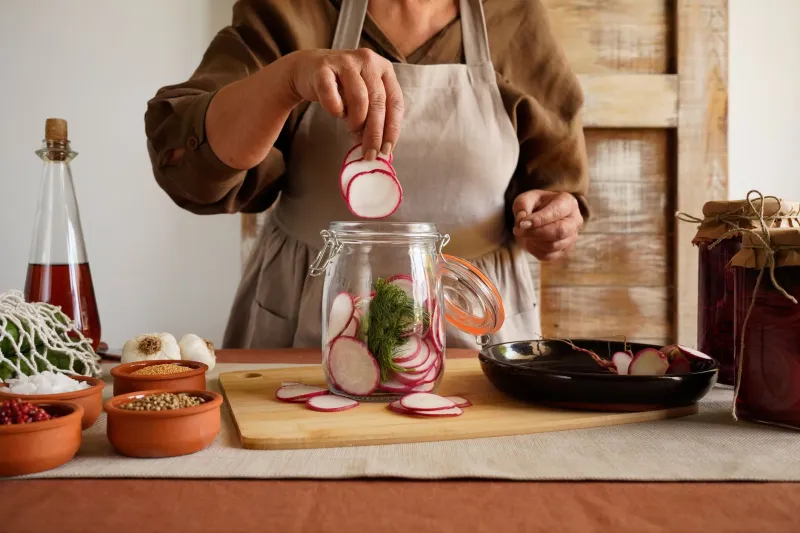
A glass jar. A wide-mouth quart mason jar runs about $2–$4 at most grocery stores or hardware stores. Ball and Kerr are the standard brands, and they're widely available across the US. That's it. That's your vessel.
A weight or a zip-lock bag filled with brine. For vegetable ferments, you need to keep your produce submerged under the liquid to prevent mold. Specialty glass weights sell for $10–$15, but a small zip-lock bag filled with salted water does the exact same job for free. "I've been using a brine bag for three years," says Marcus Okafor, a Chicago-based fermenter who sells small-batch hot sauce at local farmers markets. "Never had a mold problem."
A cloth cover or loose lid. Most ferments need airflow without full exposure. A coffee filter secured with a rubber band works perfectly for kombucha. For vegetable ferments, you can burp a regular mason jar lid daily — or just leave it slightly loose.
Salt. Not fancy fermentation salt. Not Himalayan pink salt with a special label. Plain non-iodized salt — kosher salt or sea salt — does the job. Iodized table salt can inhibit fermentation, but the non-iodized versions you find in any grocery store are fine. A 26-ounce container costs under $3.
A kitchen scale. Okay, this one is worth spending a little on. Accurate salt ratios matter in fermentation, and eyeballing it can lead to inconsistent results. A basic digital kitchen scale runs $10–$15 on Amazon and is genuinely useful across all kinds of cooking.
Total cost to get started? Roughly $15–$20, including the scale. Compare that to a $150 kit, and the math gets uncomfortable fast.
The Airlock Myth
Airlocks are probably the most aggressively marketed piece of fermentation gear out there, and they're worth addressing directly. These devices — which allow CO2 to escape while keeping oxygen out — do have a legitimate place in certain ferments, particularly home brewing and wine making. For lacto-fermented vegetables, though, they're largely optional.
"Airlock systems are great if you're fermenting for longer periods or in warm climates where you want to minimize any oxygen exposure," explains Reyes. "But for a two-week kraut? You don't need one. People have been making sauerkraut for centuries without them."
The same logic applies to specialty crocks. Traditional fermentation crocks — the kind with a water-seal moat around the lid — are genuinely lovely pieces of equipment. If you fall in love with fermentation and want to invest in one down the line, go for it. But they're not a starting point requirement. They're a graduation gift you give yourself.
Where Spending More Actually Makes Sense
None of this is to say that all fermentation gear is a scam. A few upgrades are genuinely worth it once you've caught the bug.
A good-quality thermometer matters if you're working with cultures that are temperature-sensitive, like yogurt or certain kombucha second ferments. A probe thermometer in the $20–$30 range is a solid investment. Continuous brewing vessels for kombucha — large glass dispensers with a spigot — can also be worth it once you're brewing regularly and want to streamline the process.
For sourdough bakers, a Dutch oven (if you don't already have one) makes a real difference in achieving that bakery-style crust. But again, that's a tool with broad kitchen utility, not a single-purpose fermentation gadget.
The Beginner Mindset Shift
Here's the thing nobody selling fermentation kits wants you to know: the biggest barrier to great fermented food isn't equipment. It's patience and observation. Learning to read your ferment — noticing the smell, the bubbles, the color — is what separates a confident fermenter from someone who keeps buying new gear hoping it'll fix a process they don't yet understand.
"I tell everyone who comes to my workshops to start with a single jar of sauerkraut," says Okafor. "Use a mason jar, use kosher salt, use cabbage. That's it. Once you've done that successfully, you understand the process. Then you can decide what else you might want."
That's the real starter kit: curiosity, a little patience, and a $4 jar. Everything else is optional.
Getting Started Without the Guilt Trip
If you're new to fermentation and feeling overwhelmed by the gear options out there, take a breath. You don't need a specialty store, a subscription box, or a dedicated fermentation corner in your kitchen. You need a jar, some salt, some vegetables, and the willingness to let time do its thing.
Fermentation is one of the oldest food preservation traditions on the planet. It predates refrigerators, airlocks, and certainly Amazon Prime. The microbes making your food delicious and nutritious don't need fancy equipment — and honestly, neither do you.
Start simple. Learn the process. Spend your money on good ingredients instead of expensive gadgets. Your gut — and your wallet — will thank you.